Originally a Tribute to the End of Slavery
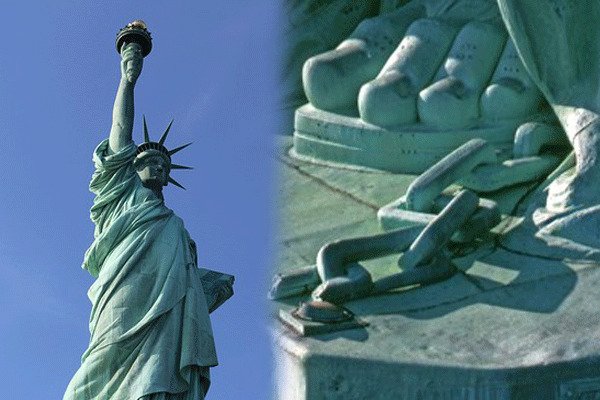
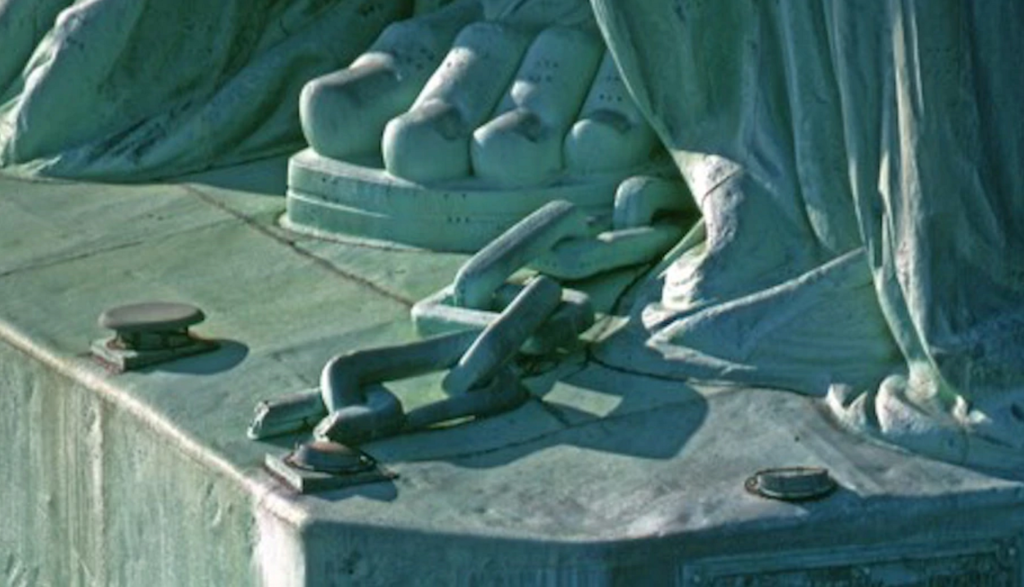
One of the most powerful symbols of freedom in the United States is the Statue of Liberty —but many do not realize she also carries a powerful message about ending slavery. The National Park Service explains that the statue includes broken chains at her feet, representing the defeat of oppression and slavery. ¹
Back in the 1860s, a French leader named Édouard de Laboulaye wanted to celebrate the end of slavery in the United States. He teamed up with sculptor Frédéric‑Auguste Bartholdi to create a giant statue that would honor freedom and human rights. The idea grew out of the political changes and the abolition of slavery after the Civil War. ⁵
The vision of universal freedom stood in sharp contrast to America’s own legal history: the Naturalization Act of 1790 had restricted citizenship exclusively to ‘free white persons,’ effectively barring Black Americans, immigrants of color, and Indigenous people from the rights that the statute was meant to celebrate. 7
In Bartholdi’s first design, the Statue of Liberty held a broken chain in her hand, showing that slavery had been defeated. This early version appears in a 1876 model preserved by the Library of Congress. ³ Later, Bartholdi changed the design, so she held a tablet with the date of American independence, and he moved the broken chain to her ankles, where she steps forward over it. The Smithsonian Magazine reports that the message of emancipation stayed the same, just less obvious. ⁴
Even though the statue is famous today, the United States did not accept it right away. Americans were supposed to pay for the pedestal, but fundraising was slow, and many people were not interested. The National Park Service describes how a nationwide campaign eventually raised enough money to finish the project. ² After years of delays, the Statue of Liberty was completed in France, shipped to New York, and officially dedicated in 1886.⁶
If you look closely today, you can still see the broken chains at her feet—a reminder that freedom means breaking away from injustice and stepping forward with courage. ¹
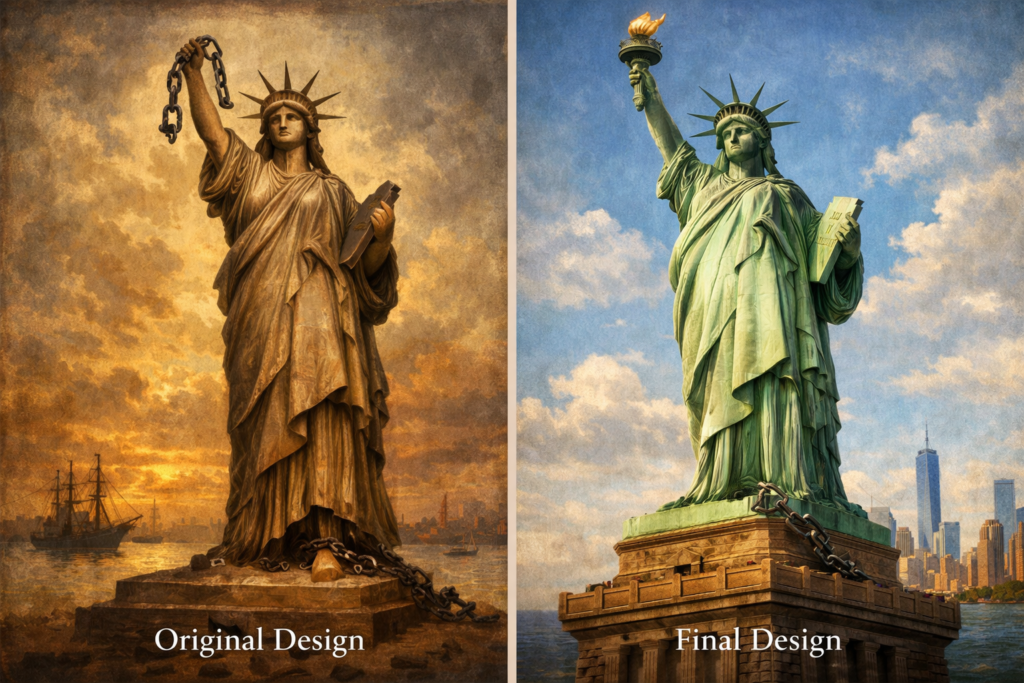
Original Design (1876) – Liberty holds a broken chain high in her left hand, symbolizing the end of slavery. Final Design (1886) – Liberty holds a tablet marked July IV, MDCCLXXVI, and steps forward over broken chains at her feet.
Footnotes:
- National Park Service, Statue of Liberty: Symbolism, U.S. Department of the Interior.
- National Park Service, The Story of the Statue of Liberty, U.S. Department of the Interior.
- Library of Congress, Statue of Liberty Enlightening the World: Bartholdi’s 1876 Model, Prints & Photographs Division.
- Smithsonian Magazine, “The Statue of Liberty Was Originally Meant to Celebrate Emancipation,” Smithsonian Institution.
- PBS, American Experience: The Statue of Liberty, Public Broadcasting Service.
- Statue of Liberty–Ellis Island Foundation, History & Construction, Statue of Liberty–Ellis Island Foundation.
- Naturalization Act of 1790, 1st Cong., 2nd sess. (March 26, 1790); see also Rogers M. Smithe, Civic Ideals: Conflicting Visions of Citizenship in U.S. History ( New Haven: Yale University Press, 1997), 116-119.